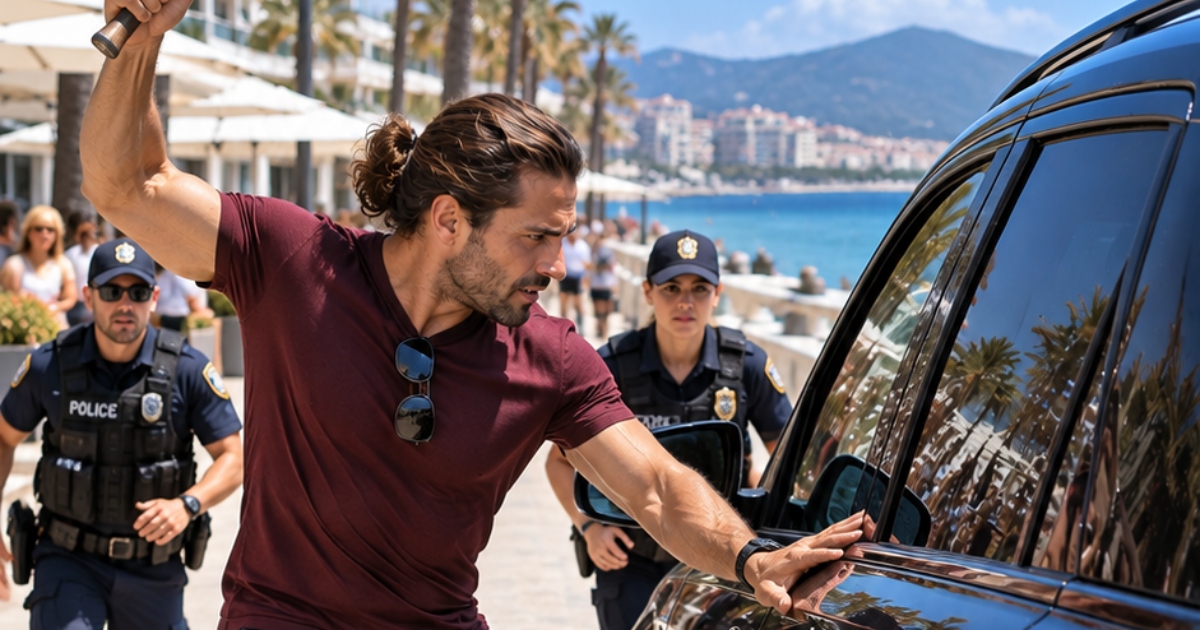
The silence didn’t just fill the promenade; it crushed it.
The paramedic hadn’t turned the sirens off. The ambulance was moving, accelerating hard past the palm trees, but the siren had simply died, leaving only the dull, heavy thrum of its diesel engine cutting through the humid heat.
Leo dropped to one knee, his fingers brushing the smooth paper of the folded envelope lying amid the debris of Elena’s spilled bag. His heart pounded in his throat. Beside him, Officer 1 was pounding the side of his radio, frustration etching deep lines into his forehead.
«Dispatch, do you copy? Radio check,» the officer barked, his voice tense. Only dead white noise answered. «Static. Complete dead zone out of nowhere.»
Leo didn’t care about the radio. He snatched the envelope and flipped it over. Written in Elena’s precise, razor-thin handwriting were three words beneath his name: Don’t follow us.
His gaze darted to the prescription bottle sitting in the dust. The label was partially torn, but the bold print of the active ingredient was unmistakable: Phenobarbital. A powerful central nervous system depressant. It was a dose far too heavy for an infant—unless the goal wasn’t just to keep a child quiet, but to mimic a medical emergency.
«Hey! Touch nothing!» Officer 1 snapped, turning toward Leo with his hand hovering near his holster. «You’re still in custody until we figure out what the hell just happened here.»
«She poisoned him,» Leo said, his voice deadly quiet as he stood up. He held out the bottle, but kept the letter tucked firmly inside his fist. «Check the seat. Check the bag. She didn’t forget that baby in the car by accident, Officer. She left him there so someone would find him.»
«That’s his mother!» Officer 2 yelled, her hands still shaking from performing compressions. «She was hysterical!»
«She’s an actress,» Leo shot back, stepping back toward his own rented sedan parked across the street. «Look at her companion. Look at the cafe!»
Officer 1 looked over his shoulder toward the shaded patio where Elena had been sitting minutes before. The man in the bespoke suit was gone. His table was completely clear—no espresso cups, no napkin, no trace he had ever existed.
A cold chill washed over Leo despite the stifling afternoon heat. He looked down the boulevard. The ambulance was already half a mile away, taking a sudden, illegal sharp left off the main avenue, veering away from the regional hospital and heading directly toward the industrial port districts.
«They aren’t taking him to the ER,» Leo muttered, realization striking him like a physical blow.
He didn’t wait for the officers to process the discrepancy. Leo turned on his heel and sprinted across the four-lane promenade.
«Halt! Stay right there!» Officer 1 roared, the sound of leather gear snapping as he gave chase.
Leo ignored him, diving through the open driver’s window of his rental car, slamming his foot on the push-start button, and jamming the shift lever into drive. The tires screeched against the hot asphalt as he executed a violent U-turn, clipping the curb and spraying dry palm fronds into the air. In his rearview mirror, Officer 1 was frantically radioing for backup—a call that Leo knew wouldn’t go through if the strange localized signal dead-zone held.
He floored the accelerator, keeping the flashing red lights of the distant ambulance in his sight line as it wove through the gridlocked port traffic.
As he drove, Leo used his thumb to tear open the envelope with one hand. Inside was a single high-resolution photograph.
It wasn’t a picture of Elena. It was an official military identification badge, worn around the neck of a man Leo recognized all too well—his former commanding officer from his search-and-rescue unit, a man who had officially died in a helicopter crash in northern Iraq four years ago.
Across the bottom of the photo, written in red marker, was a single date: Today.
Leo’s grip tightened on the steering wheel until his knuckles turned ghostly white. The pieces were shifting, reordering themselves into a picture far more sinister than a mother abandoning her child. Elena hadn’t been fleeing a bad marriage. She had been running a delivery.
Leo’s grip tightened on the steering wheel until his knuckles turned ghostly white. The pieces were shifting, reordering themselves into a picture far more sinister than a mother abandoning her child. Elena hadn’t been fleeing a bad marriage. She had been running a delivery.
Up ahead, the ambulance plunged into the shadow of a massive, cavernous shipping warehouse at the edge of Dock 14. Its brake lights flared once, twice, and then went completely dark.
Leo cut his own headlights, coasting silently into the alleyway adjacent to the warehouse entrance. The air here smelled thick of salt water, diesel exhaust, and rust. He stepped out of the car, pulling his tactical glass-breaker from his pocket—his only weapon—and crept toward the cracked metal side door of the structure.
Inside, the light was dim, filtered through filthy skylights overhead. The ambulance sat parked in the center of the vast concrete floor, its rear doors swinging wide and empty.
No paramedics. No Elena. No baby.
Then, a quiet, metallic click echoed from the shadows directly behind him.
«You always were too quick to jump into a fire, Leo,» a calm, familiar voice rasped from the darkness.
Leo froze, slowly raising his hands as he turned around. Standing in the gloom, holding a suppressed pistol leveled directly at Leo’s chest, was the man in the bespoke suit from the cafe.
Except up close, under the harsh industrial light, Leo saw the jagged surgical scar running from the man’s ear down into his collar—the exact signature mark of his supposedly deceased commander.
«Where is the child?» Leo asked, his voice steady despite the gun trained on his heart.
The man offered a dry, humorless smile. «What child, Leo? Take a closer look at the car seat in your memory. Did you ever actually hear him cry?»
Before Leo could process the question, a heavy iron gate slammed shut behind him, locking him inside the warehouse. From high above in the rafters, a child’s sudden, piercing wail rang out through the rafters—followed immediately by the distinct, mechanical hum of a countdown timer beginning to tick.